Free NewsletterPro Login

Mexico Unveiled A $7,500 Homegrown EV To Cut US Reliance

Published Jun 8, 2026
Share:
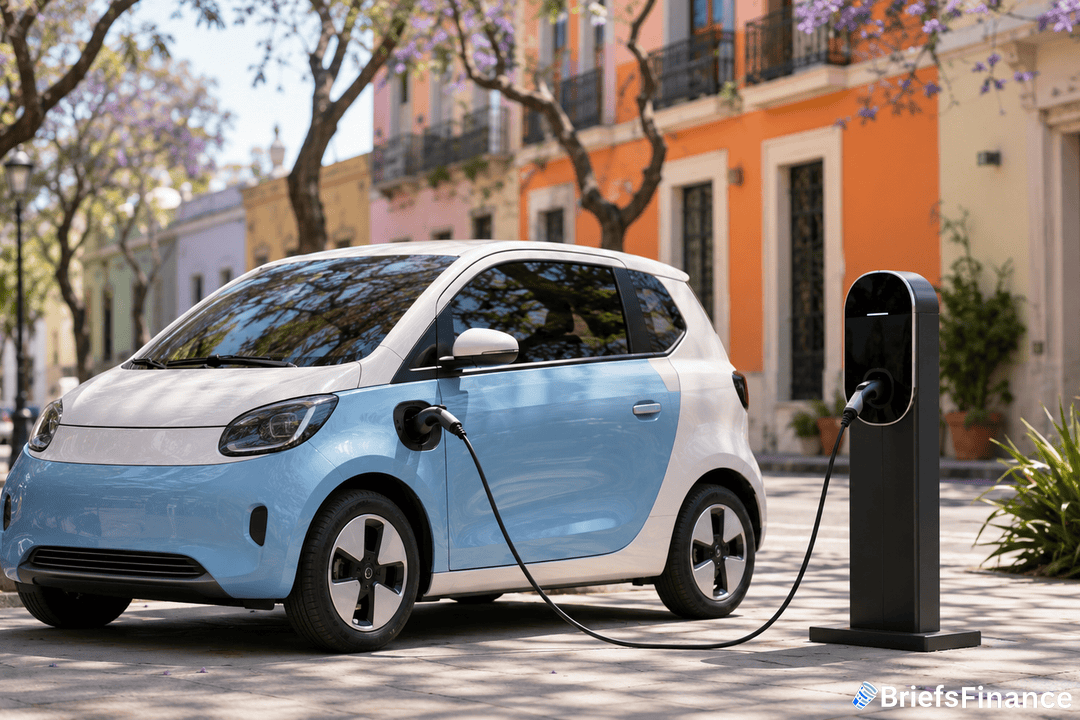
A small blue and white electric car is parked on a street, plugged into a charging station. Colorful buildings and flowering trees line the background. The BriefsFinance logo appears in the corner.
Summary:
  • Mexico's government showed off Olinia 1, its first fully homegrown EV, priced from about 150,000 pesos ($7,500).
  • The city car tops out at 50 km/h with a range of more than 125 km per charge.
  • Sales are slated for the second half of 2027, with an assembly plant in Puebla due by the end of 2026.

Most of Mexico's car industry is built to sell to the US. Its newest car is built so it doesn't have to.

A Car Made To Cut The Cord

President Claudia Sheinbaum drove the prototype onto the stage herself. The car is called Olinia 1.

It is the first electric vehicle designed and built fully in Mexico. Teams at public schools like the IPN built it over two years.

Sheinbaum framed it as a win for young talent. She said local students turned creativity into real progress.

The goal is simple and bold. Build a cheap car that regular families can buy.

And it is cheap by design. Prices start around 150,000 pesos, or about $7,500.

That makes it one of the most affordable EVs in the country. This is a city car, not a highway cruiser.

It seats six and tops out at 50 km/h. The battery is small at 14.7 kWh.

Even so, it goes more than 125 km on a charge. The reveal landed just before the 2026 World Cup, a proud moment for the country.

Trade and tariff shifts move markets fast - we translate them into plain English each morning in Market Briefs, plus a free investing masterclass when you join.

The Tariff Math Behind It

The timing is not random. US tariffs of 25% on cars hit Mexican plants hard.

The US also ended its EV rebates. That wiped out demand for models Mexico built for export.

The export hit was real. US buyers had taken EV models that Mexico made just for them.

When that demand dried up, plants felt it fast. Building for the home market spreads out the risk.

The shift also keeps jobs at home. That matters in towns built around car plants.

So Mexico is changing the plan. It wants to build demand at home instead.

The cost math helps its case. The little car runs at about 49 centavos per kilometer.

A gas car costs 2.40 pesos for the same distance. Those savings can top 50,000 pesos a year.

The stakes are huge. Cars make up about a fifth of Mexico's factory output.

What To Watch

There is a long road from prototype to driveway. Sales are not expected until the second half of 2027.

First, a plant in Puebla must be running by the end of 2026. Mass output is set to start in early 2027.

A cargo version is coming as well. Mexico plans to show that model in July.

Plenty could still go wrong on the way. New car projects often slip past their dates.

The government is planning the road ahead, too. It wants 2,000 charging points and a swap of city taxis for Olinia cars.

Still, the plan has the full backing of the state. If it works, cheap local EVs could spread fast.

For years, Mexico built cars for America. This one it is building for itself.

Get the stories driving the global economy every weekday morning - sign up for Market Briefs and a 45-minute investing course is included.

Disclosure

Get Market Briefs delivered to your inbox every morning for free!

No fluff. No noise. No politics. Just finance news you can read in 5 minutes.

Blogs

May 30, 2026
Financial Literacy Books That Actually Build Wealth
  • The best financial literacy books don't just teach budgeting, they shift how you think about money.
  • Two classics stand out: The Intelligent Investor for valuing investments, and Rich Dad Poor Dad for the owner's mindset.
  • Reading is only step one. The real wealth comes from acting on what you learn.
Read More
May 30, 2026
What Is a Roth Conversion? A Simple Guide
  • A Roth conversion moves money from a traditional retirement account into a Roth account.
  • You pay taxes on the money now, in exchange for tax-free growth and withdrawals later.
  • It can pay off if you expect higher taxes or more income in the future, but the timing and tax hit matter a lot.
Read More
May 30, 2026
Trailing Stop Loss: How to Protect Your Gains
  • A trailing stop loss is an order that automatically sells a stock if it falls a set percentage from its recent high.
  • As the stock rises, the sell point rises with it, locking in gains while capping losses.
  • It's most useful for active strategies like momentum investing, not for long-term buy-and-hold.
Read More
May 30, 2026
5 Types of Wealth: Why Money Is Only One of Them
  • Real wealth is more than a bank balance. It spans your finances, health, mind, purpose, and freedom.
  • Money is powerful, but it amplifies the life you already have rather than fixing a broken one.
  • True financial wealth means your cash flow covers your expenses, so your money works while you live.
Read More
May 30, 2026
How to Invest in Private Equity: A Beginner's Guide
  • Private equity means investing in companies that aren't listed on the stock market.
  • Traditional private equity is built for experienced, high-net-worth investors with large amounts to invest.
  • New rules have opened more accessible paths, like startup crowdfunding and real estate deals, often starting around $100.
Read More
May 30, 2026
What Is a Call Option? A Simple Guide With Examples
  • A call option gives you the right to buy a stock at a set price by a set date.
  • Investors buy calls when they expect a stock to rise, using less money than buying the shares outright.
  • The most you can lose buying a call is the premium, but time works against you, so it's an advanced tool.
Read More
May 30, 2026
EBITDA Formula: How to Calculate It Step by Step
  • EBITDA stands for Earnings Before Interest, Taxes, Depreciation, and Amortization, a measure of a company's core profit.
  • The formula adds those four items back to net income to show what the underlying business earns.
  • Investors use EBITDA to compare companies and to judge how many times earnings a stock is selling for.
Read More
May 30, 2026
What Is a Stock Option? A Plain-English Guide
  • A stock option is a contract giving you the right, but not the obligation, to buy or sell a stock at a set price by a set date.
  • There are two types: calls (the right to buy) and puts (the right to sell).
  • Options are powerful but risky, so they suit investors who already have the basics down.
Read More
May 30, 2026
Put Option: What It Is and How It Works
  • A put option gives you the right to sell a stock at a set price by a set date.
  • Investors use puts to bet a stock will fall, or as insurance to protect shares they own.
  • The most you can lose buying a put is the premium you paid, which makes it a defined-risk tool.
Read More
May 30, 2026
Operating Margin: What It Is and How to Calculate It
  • Operating margin shows how much profit a company keeps from its core business after paying its running costs.
  • The formula is operating income divided by revenue, shown as a percent.
  • A strong, steady operating margin signals a well-run business that controls its costs.
Read More
1 2 3 22
Share via
Copy link










